Showing posts with label Neighborhoods. Show all posts

Monday, May 4, 2009

Fighting Foreclosed Home Blight

Calculated Risk has a post here detailing efforts some cities are making to force lenders to maintain the vacant homes they’ve foreclosed.

Apart from the obvious fact that blight upsets constituents, attacking blight aggressively is good policy because it helps maintain values (and tax bases). I came to this view via Wesley Skogan’s Disorder and Decline and George Kelling’s Fixing Broken Windows, both of which should be required reading for real estate investors, appraisers, and lenders. The latest research provides additional support for the idea that disorder leads more disorder, creating a self-reinforcing downward spiral.

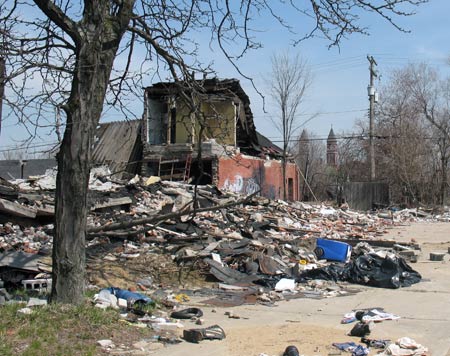
Although Detroit’s economic problems are severe, I wonder if it would have made a difference if funds had been available in the past to keep the place cleaned up.

A city in ruins

Friday, May 1, 2009

When Real Estate Is A Liability: The Movie

I’ve previously posted about how real estate values can fall close to zero here and here, and the importance of completing projects here. This video of new homes being demolished at the direction of the foreclosing bank takes the concept to a whole new level:

This is not as crazy as it appears when you know the bank’s side of the story, available on this post from Vision Victory Manifesto (also the video source). An excerpt:

“Our only option is to either proceed with putting more than a million bucks into the land, which we’ve already taken a huge hit on and lost a lot of money, or, we tear down the houses,” Smith [Guaranty Bank official, Real Estate Officer Dean Smith] said.

He said the builder put up the homes before completing the site improvements and failed to have enough money to finish roads, walls, and other improvements that bring the community into code.

“Everything just fell apart at that point and we can’t sell homes that are not up to code,” Smith said.

He said the city of Victorville fined the bank once because the home are out of code and would have faced daily fines if Guaranty didn’t do something with the vacant houses.

“There are still substantial dollars that need to be put into the land before the city of Victorville will give certificates of occupancy on the houses and the bank isn’t willing to put forward that amount of money,” Smith said.

If the bank was just looking at the cost of finishing the houses, it probably would have made sense to do so. But, when you have to put in roads and other site improvements too, that probably tipped the scales in favor of demolition. Obviously, it’s really bad lending practice to advance funds for house construction and not have enough in the budget to build the roads to the houses.

Another factor was that, in the bank’s view, it would be at least five years before the market recovers to the point the houses would sell. That’s believable, given the market is Victorville. The video mentions other homes being demolished in Temecula, which is also a distant exurb:

image

More on the problems exurbs are experiencing here, here, here, and here. Neither the video nor post identifies an exact location of the homes being demolished, but here’s an image of the crossroads mentioned:

image

The combination of exurb market, fringe location, and poor construction loan administration will result in losses in this kind of market.

Wednesday, April 8, 2009

Borrower Credit Standards and CRE Loans

CRE lenders are much more focused on the real estate than on borrowers. Loans to people like Shashikant Jogani are the result.

I’ve already mentioned Jogani a few times in previous posts (why single asset borrower structures are a good idea, and Jogani was the owner of the building with the collapsed ceilings I mentioned in this post on maintenance). His story is an interesting one, which is publically available courtesy of Shashikant Jogani v. Haresh Jogani, et. al., California Court of Appeals B181246 (Los Angeles County Super. Ct. No. BC290553). In this case Jogani was suing his brother and other family members for $250M. Some excerpts:

In 1979, plaintiff Shashikant Jogani (who prefers to be called Shashi on appeal) began investing in residential apartment properties in and around Los Angeles County. By 1989, he owned properties having a fair market value of $375 million and a net equity of $100 million. Because of an economic recession that started in the late 1980’s and continued into the mid-1990’s, Shashi faced defaults and foreclosures on valuable properties.

In April 1995, Shashi entered into a general partnership (Partnership) pursuant to an oral agreement (Partnership Agreement) with his brothers, Haresh Jogani, Rajesh Jogani, Chetan Jogani, and Sailesh Jogani. Shashi transferred ownership of his properties to the Partnership. Thereafter, the properties were held nominally by several corporations created for that purpose, namely, J.K. Properties, Inc., H.K. Realty, Inc., Hansa Investments, Inc., Commonwealth Investment, Inc., Mooreport Holdings Limited, and Gilu Investments Limited (collectively Partnership Entities). Under the Partnership Agreement, the Partnership actually owned these corporations notwithstanding nominal ownership in the names of certain of Shashi’s brothers and other relatives…

Shashi’s brothers were to receive all proceeds (“profits, sale, refinancing”) until they recouped their investment plus a return of 12 percent. Once that occurred, Shashi was to receive one-half of all “profits, proceeds, and value” concerning the Partnership and its properties.

Market conditions got worse:

By the mid-1990’s, the equity in Shashi’s real estate holdings had fallen from $100 million to a negative $50 to $70 million. There were several lawsuits against him, brought by tenants, creditors, employees, and an insurance company. By 1998, many creditors had obtained judgments against him.

Then market conditions got better:

In November 2001, after several years of work, Shashi became entitled to his 50 percent share. He was paid $2.4 million at that time.

The falling out:

In June 2002, the Partnership owned properties having a fair market value in excess of $1 billion and a net equity of around $550 million. Under the Partnership Agreement, Shashi was entitled to $225 million. Nevertheless, Haresh, acting on behalf of himself and the other brothers, refused to honor the Partnership Agreement, removed Shashi from management of the Partnership’s properties, and recharacterized the $2.4 million payment as a loan, demanding it be repaid.

In February 2003, Shashi filed this action against his brothers, other relatives, and the Partnership Entities.

Now, you would think that a borrower who had multiple lawsuits and judgments of record might have trouble getting CRE loans. and that the lawsuit excerpted above might raise a red flag. But you would be wrong. Deutschebank, JP Morgan Chase, and Wachovia all funded multiple loans to Jogani after these events.

And how are Jogani’s deals doing this time around? Here are some indications:

From a December 27, 2008 NewsOk story:

City officials have been wrangling with Eagle Point’s owner, Shashikant Jogani of Glendale, Calif., over its deteriorating condition.

Jogani owns two other Del City complexes, Logan Point Apartments, 481 Scott St., and Kristie Manor Apartments, 5236 SE 29. City officials have deemed both unfit for human occupancy due to health and safety violations. Remaining tenants have been given until Jan. 15 to find new homes.

And this November 17, 2008 NewsOk story:

Tommy McDonald said the view of the apartment complex from his back porch is like glimpsing into a war zone. And now that a pizza delivery driver was shot to death there last week, he’s certain it’s turning into one.

Nov 16 Residents of Lantana Apartments in Oklahoma City are frustrated with the conditions and unable to force the apartments owners to fix the problems.

McDonald’s home is about 50 feet from Lantana Apartments, with its graffitied walls, shattered windows, doors teetering off broken hinges and waist-deep grass.

"I want to see them bulldozed,” McDonald said. "It’s disgusting.”

Lantana Apartments, 7408 NW 10, is one of 14 properties in the state The Oklahoman has linked to California real estate investor Shashikant Jogani. Oklahoma City, Del City and Pauls Valley officials are grappling with Jogani over poorly maintained complexes.

Lantana specifically has been targeted for numerous code violations and maintenance issues with Oklahoma City, county and state officials. Police say its condition makes the area conducive to crime.

A borrower’s track record doesn’t fit as neatly into a model as a property’s LTV or DSC, and there’s always a story to explain what went wrong last time, and what will be different this time. As a result, there is always a lender for any borrower regardless of what’s happened in the past.
Thursday, March 19, 2009

Exurbs: How Far Is Too Far?

I’ve previously posted about why the nation’s worst housing markets are in the exurbs. A reader commented:

There has to be a sweet spot for these exurb communities. How far is just right to commute? 30 minutes one way? 45? Surely people think nothing of traveling across a city for work at 50 minutes per trip, so living 30ish miles out of town really isn't as bad. So, how far is too far?

The short answer is, if the commute is more from 30 minutes one way, it’s too much. Tom Vanderbilt, from his book Traffic: Why We Drive the Way We Do:

In the 1970’s, Yacov Zahavi, and Israeli economist working for the World Bank, introduced a theory he called the “travel time budget.” He suggested that people were willing to devote a certain part of each day to moving around. Interestingly, Zahavi found that this time was “practically the same” in all kinds of different locations. The small English city of Kingston-upon-Hull’s physical area was only 4.4% the size of London; nevertheless, Zahavi found, car drivers in both places averaged three-quarters of an hour each day. The only difference was that London drivers made fewer, longer trips, while Kingston-upon-Hull drivers made frequent, shorter trips. In any case, the time spent driving was about the same…

There seems to be some innate human limit for travel – which makes sense, after all, if one sleeps eight hours, spends a few hours eating (and not in the car), and crams in a hobby or a child’s tap dance recital. Not much time is left. Studies have shown that satisfaction with one’s commute begins to drop off at around 30 minutes each way.

However, obviously many people spend more than an hour a day in total commute time. Why is that? Jonah Lehrer suggests it’s a weighting mistake, in his book How We Decide:

As Ap Dijksterhuis, a psychologist at Radboud Univeristy, in the Netherlands, notes, when people are shopping for real estate, they often fall victim to…what he calls a “weighting mistake.” Consider two housing options: a three bedroom apartment located in the middle of the city which will give you a ten minute commute, and a five-bedroom McMansion in the suburbs which will result in a 45 minute commute. “People will think about this trade-off for a long time,” Dijksterhuis says, “and most of them will eventually choose the large house. After all, a third bathroom or an extra bedroom is very important for when Grandma and Grandpa come over for Christmas, whereas driving two hours each day is not really that bad.” What’s interesting is the more time people spend deliberating, the more important that extra space becomes. They’ll imagine all sorts of scenarios (a big birthday party, Thanksgiving dinner, another child) that turns the suburban house into a necessity. The lengthy commute, meanwhile, will seem less and less significant, at least when it’s compared to the lure of an extra bathroom. But, as Dijksterhuis points out, the reasoning is backward: “The additional bathroom is a complete superfluous asset for at least 362 or 363 days each year, whereas a long commute does become a burden after a while.”

I think it’s a big mistake to locate housing more than 30 minutes from major employment centers. Strategies which depend on people making errors in judgment usually don’t work out well in the long run.

Tuesday, March 17, 2009

Turning Around the Creston Apartments

Here’s an interesting account of efforts to turn around a high crime, poorly maintained apartment project in Kansas City which was affecting the entire neighborhood. The short version:

  • Aggressive policing
  • Political involvement
  • On site security
  • Maintenance

I’m not sure if this can really be categorized as a success story though, since it apparently ends in the demolition of the project.

Saturday, March 7, 2009

Order, Disorder, and Good Neighborhoods

I’ve posted a few times about the idea that real estate values do better in neighborhoods that are well maintained and perceived as safe by their residents (see here and here).

Via Schneier on Security,, some recent research supporting the Broken Windows theory of policing:

Researchers, working with police, identified 34 crime hot spots. In half of them, authorities set to work—clearing trash from the sidewalks, fixing street lights, and sending loiterers scurrying. Abandoned buildings were secured, businesses forced to meet code, and more arrests made for misdemeanors. Mental health services and homeless aid referrals expanded. In the remaining hot spots, normal policing and services continued…

Cleaning up the physical environment was very effective; misdemeanor arrests less so, and boosting social services had no apparent impact.

Thursday, February 26, 2009

Abandoned Homes, Troubled Neighborhoods, and Foreclosures

This photo (hat tip Zillow) is the World Press Photo of 2008:

foreclosure world-photo

According to jury chair MaryAnne Golon:


The strength of the picture is in its opposites. It’s a double entendre. It looks like a classic conflict photograph, but it is simply the eviction of people from a house following foreclosure. Now war in its classic sense is coming into people’s houses because they can’t pay their mortgages.

That’s an interesting take, but it’s not what’s going on. The original caption for the photo says:


When Detective Cole finds a home that is already abandoned or vacant, he enters with his weapon drawn, to guard against squatters.

Squatters in abandoned homes are a much bigger risk than former owners and tenants, and abandoned homes are a major detriment to neighborhoods (more about that here). But, it’s not quite as dramatic as imagining warfare between the state and people who have lost their homes.

The photo is part of a great series you can see here.

Thursday, February 19, 2009

Best Article Yet on the Residential Housing Collapse

George Packer has written a great article, The Ponzi State, in the February 9 New Yorker (the link is to the abstract but the full article requires a payment if you’re not a New Yorker subscriber). Here is an excerpt:

Driving around Florida’s ghost subdivisions, if feel not just that their influence is waning but that they are physically hollowing out. In a place like Lehigh Acres, near Fort Myers, where half the driveways are sprouting weeds, and where garbage piles up in the bushes along the outer streets, it’s already possible to see the slums of the future. More and more of the residents in Hamilton Park will be renters like Lee Gaither. The vacant houses in Country Walk will be boarded up. The St. Augustine grass in the front yards of Tanglewood Preserve will grow three feet high. The open fields with street lights but no houses will become dumps.

Sunday, February 15, 2009

Underwater Homes, Exurbs, and Income

Paul Kedrosky’s Infectious Greed picks up on a story in the San Diego Union Tribune which has an interesting graphic of the percentage of underwater homes in San Diego County by zip code:

image

(Click on image for a larger version in a new window)

I agree with Paul that the full map tells the story as an exurb phenomenon (I’ve posted on that in more detail here) and relates to vintage (more on that here).

I also think the inset has something interesting to say about household income and underwater homes. The inset area is not an exurb, but there is big variation in the percentage of underwater homes across a relatively small swath of San Diego. Here’s a blowup of a piece of the inset:

image

Best to worst performance is light grey, yellow, orange, red, dark grey.

Now, here’s a UUorld map of average household income (2000) for the same swath:

image

(Click on image for a larger version in a new window)

Note how the higher income neighborhoods have fared better. I’ve written more about that here.

Thursday, January 29, 2009

The Landes Apartments Project has the Best Multifamily Location in the Whole World

OK, I don’t know this for sure, because I haven’t visited every multifamily site in the whole world. But, I think this location (901 8th Avenue, Seattle, WA) is a contender. Here is my logic:

  1. The best apartment location should perform well in difficult market conditions.
  2. In difficult market conditions, the sectors which perform best are government, health, and education.
  3. The Landes location is ideally suited to appeal to government, health, and education workers.

With regard to the second premise, there is a helpful post at Macro and Other Musings titled "Where are the Safe Jobs?". Here is a chart from that post:

image

By far the most jobs have been created in the government and education/health services sectors. This is not a fluke of this recession – Eric Janszen put together charts of every sector showing data back to 1940 (posted here) and reaches the same conclusion.

So here is the location of the Landes Apartments (“A” on the Google Map below):

image

Easy walking distance to Seattle University, three major medical centers, and the Seattle/King County government buildings (shaded in red at the lower left).

There might be better locations, but I don’t know of any.

Saturday, January 24, 2009

Foreclosures in the Exurbs

Foreclosures are concentrated in the exurbs. I’ve previously posted here about how this is primarily a vintage problem; in these new developments the houses were sold and financed in a relatively short time frame at the peak of the market using aggressive financing, and hence when the downturn occurred these neighborhoods have been hit in a very concentrated way.

Green Valley Ranch, a development on the outskirts of Denver, is a poster child for this problem. From an April, 2008 USA Today story:

This small corner of the Mile High City represents an extreme example of how foreclosures are transforming lives and neighborhoods. On some blocks, as many as one-third of the residents have lost their homes, making this one of the worst hotspots in a city that was among the first to feel the pinch of the foreclosure crisis. Many houses here remain empty, bank lockboxes on the front doors…

     Many neighborhoods in Denver and across the nation have largely been spared from that tide, but others have been hammered.

     That's especially true here, along the broad avenues of Green Valley Ranch, a remote subdivision of soft-colored houses with red-tile roofs sewn into the vast carpet of flat, open land on the city's eastern edge. As Denver's housing market boomed at the beginning of this decade, the area became a magnet for low- and middle-income families buying their first homes in the kind of brand-new neighborhood they once thought would always be beyond their reach. Some turned to more-expensive subprime loans, which charged higher interest rates to borrowers with bad credit. Others got adjustable-rate mortgages and saw their payments increase sharply after two years.

This is Green Valley Ranch’s location:

image

Here is a map from the USA Today article showing foreclosure activity in the neighborhood between 2006 and 2008:

image

(Click on image for a larger version in a new window)

Note that this is happening in Denver, where home prices have  remained relatively stable (see this post for information on Denver’s performance relative to other markets).

Thursday, January 22, 2009

Why Are the Nation’s Worst Housing Markets in the Exurbs?

Housing Wire has a list of the 20 worst housing markets in the United States, as measured by the percentage of homes which are worth less than their mortgages. Here are Google satellite photos of the worst 4:

#1 Zip 95391, Mountain House, CA. You can read more about this unfortunate place in this New York Times article.

95391

#2 Zip 89166 (Clark County, NV):

89166

#3 Zip 89178 (Clark County, NV):

89178

#4 Zip 95742 (Sacramento County, CA):

95742

See a pattern? All of these are new developments at the outskirts of suburban areas.

There is a theory that the collapse of these nascent communities is attributable to high gas prices (see this post in Econbrowser and this article in Muninet Guide, for example). That might have been a contributing factor, but it’s not the primary problem.

The primary problem is one of vintage. In a developed neighborhood, only a small percentage of homes sell and are refinanced in any given time period. In a new development, everyone buys and finances in a relatively compressed time frame. These communities all hit the market during the peak of the underwriting craziness, so a much higher percentage of homes in these areas ended up overleveraged.

Tuesday, January 13, 2009

What Make a Good Neighborhood?

A study published in the Journal of Environmental Psychology on the preferences of active independently living seniors (55 to 80)reports:

Positively related to perceived attractiveness of links were the following street characteristics: slopes and/or stairs, zebra crossings, trees along the route, front gardens, bus and tram stops, shops, business buildings, catering establishments, passing through parks or the city centre, and traffic volume. Litter on the street, high-rise buildings, and neighborhood density of dwellings were negatively related to perceived link attractiveness. Overall, the results suggest that three main aspects affect perceived attractiveness of streets for walking, namely tidiness of the street, its scenic value and the presence of activity or other people along the street.

I think this research complements my previous posts on the negative impact disorder has on neighborhoods.

Monday, January 12, 2009

Low End Housing Gets Hammered in a Recession

Lansner on Real Estate reports the low-end Los Angeles / Orange County home price loss is nearly twice the high end:

image

I’ve posted before on why low end multifamily underperforms in a recession, and I think the same logic holds for single family values. I think this is also consistent with my argument that part of the reason some markets bubbled more than others is the markets had a high percentage of rental single family housing (discussed here). My conjecture is probably much of the low end houses trading now were probably originally rentals that were sold to owners, were foreclosed on, and are now shifting back to rental stock at prices that can be supported by rents.

Thursday, December 25, 2008

Making the Neighborhood Stabilization Program Work

The Wall Street Journal reports local jurisdictions are having a hard time figuring out how best to spend the $4B HUD is distributing to them to help stabilize neighborhoods experiencing high level of foreclosures. Here are my suggestions, based on my experience at the Los Angeles Housing Department helping rebuild neighborhoods devastated by the Northridge earthquake.

The Northridge quake left tens of thousands of homes and rental units vacant and damaged. Some neighborhoods were affected much more than others, but in every neighborhood there were owners whose housing was not damaged, so comprehensive redevelopment was not an option. There was a real possibility some of the neighborhoods would remain blighted indefinitely if dramatic steps weren’t taken. Many homes and apartment buildings were either foreclosed upon or required lender cooperation in the reconstruction. The quake occurred in January, 1994, a time in Los Angeles when many residents and apartment owners had lost all the equity in their units due to economic conditions even before the earthquake. The parallels between this situation and foreclosure blighted neighborhoods is obvious.

In an effort to preserve the damaged housing HUD provided the City of Los Angeles with $400M in CDBG and HOME funds. The Los Angeles Housing Department developed programs which were extremely successful, and two years later almost all the affected properties in the target areas were back on line. Here's a link to a study published in 2000 which summarized the reconstruction.

The most important decision made was to leverage rather than replace private sector funding sources. The mechanism to accomplish this was to offer subordinate loans at 0% interest payable over 30 years with no payments for the first five years. The amount of the loan was capped at $35,000 per unit, the loans were only available in target areas (described below), and became due when the property was sold. This approach had several benefits:

  • The very favorable terms concentrated private sector reinvestment in the target areas
  • The predictable loan amount allowed buyers and sellers to factor the financing into their negotiations
  • The loan structure (as opposed to direct investment or a grant) created an annuity for the Housing Department; as the loans have been repaid the money is available for recycling into new programs.
  • Between three and four times as many units were assisted as would have been possible if only public funds were involved.

Another key decision was making the funds available for rental housing. When the loan was made on a rental unit, an income restriction was placed on the unit which at that time was above market, so there was no impact on the rent charged or the value of the unit. However, as rents have increased in Los Angeles these units have become an important component of the affordable housing stock. A restriction limiting the unit to tenants making 60% or less of the area median income would not have an immediate impact in most low and moderate income foreclosure neighborhoods, and would help ensure housing affordability in the years to come.

Other key components of the programs were:

  • A detailed inventory of the affected housing. An inventory is necessary both to select target areas and to monitor progress. This step is particularly important if there’s a possibility of getting more money if your programs are successful (which is probably going to be the case with the Neighborhood Stabilization Program). Information on foreclosures is readily available but constantly changing, so an active database (as opposed to a static snapshot) is necessary.
  • A focus on the areas which are most seriously affected, while paying attention to political geography. The Los Angeles Housing Department designated 17 neighborhoods as “Ghost Towns”, which were characterized by high concentrations of damage. Although these areas were primarily determined by need, a secondary consideration was to identify at least one neighborhood in each city council district that would receive funds. This was an important step to ensure broad political support in Los Angeles’ often fractious local government. Again, the foreclosure data is readily available but needs to be analyzed and monitored.
  • A multi-department effort. Although the Housing Department had primary responsibility for the effort, other departments played important roles. For example, the Department of Building and Safety, Public Works, and General Services played an important role in boarding up and securing vacant buildings, and the Los Angeles Police Department stepped up patrols to deal with disorder issues and squatters in the affected neighborhoods. Foreclosure-ravaged neighborhoods have similar needs.

Additional information on the programs is described in this report by the LA Housing Department. Compare this effort to the dismal housing reconstruction progress in New Orleans, where, for example, only 82 of an estimated 10,000 damaged rental homes have been brought back on line in the three years since the disaster.

The is an unfortunate tendency to want to treat each disaster as unique and to create new solutions, as opposed to adopting proven approaches which were created elsewhere. I hope this housing disaster will be different.

Friday, December 5, 2008

Neighborhoods, Disorder, and Real Estate Values

Bad neighborhoods equal bad real estate performance. Most real estate professionals would agree with that statement, but a lot of us feel uneasy saying it, because historically bad neighborhoods have been defined by red lines on maps and linked to the resident’s income level and race. I have touched on this topic a few times before (here and here), but a recent study summarized in The Economist reminded me this is something I wanted to write about in more detail. What exactly constitutes a bad neighborhood, and how does a bad neighborhood hurt real estate values?

My view is as follows:

  • A bad neighborhood is a neighborhood where there are visible signs of decline and disorder. These signs include poorly maintained buildings, landscaping, and infrastructure, graffiti, litter, and indications of criminal activity (e.g., drug dealing and use, prostitution).
  • Responsible people (which I’ll define in a very limited sense as people who pay their mortgages and rent when due) do not like to be around disorder.
  • The aversion of responsible people to disorderly neighborhoods results in less demand for housing in those neighborhoods, resulting in lower values.

I came to this view via Wesley Skogan’s Disorder and Decline and George Kelling’s Fixing Broken Windows, both of which should be required reading for real estate investors, appraisers, and lenders. The latest research provides additional support for the idea that disorder leads more disorder, creating a self-reinforcing downward spiral.

Is approaching real estate investing or lending in a disorderly neighborhood more cautiously really just redlining in disguise? After all, aren’t such neighborhoods typically lower income, and aren’t the residents typically minorities?

One of the findings in Skogan’s research which really struck me was the fact that minorities and low income residents hate disorder in their neighborhoods as much as wealthier and white residents do. The income level and race of residents is not the cause of disorder, and they would be happy to be free of it. If you want to eliminate disorder in a neighborhood, you do it by allocating public funds to maintain and police the neighborhood properly. It’s true that minority and low income neighborhoods often get the short end of the stick when it comes to resource allocation. That’s a public sector problem that will not be fixed by private investment.

Sunday, November 30, 2008

50 Reasons to Dislike a Multifamily Project - Neighborhood Issues

Back in the early 1980’s I was a hatchet man for a multifamily lender that had a full pipeline but didn’t want to do any more business. My job was to review the loan request, visit the site if necessary, and find a way to kill the deal without getting sued.

I quickly learned this was a surprisingly easy task; there are few multifamily projects that don’t have flaws. Over the years I’ve refined the list, and I’ve settled in on 50 factors, which I’ll itemize in the next few posts.

Obviously, if you view all 50 as deal killers you’ll never make a loan. In fact, there are just a handful I would consider extremely important. The others are listed because there is some logic to the objection, and in combination with other factors may be a good reason not to do a deal.

This post deals with issues in the neighborhood. The first two issues are very important because they substantially reduce potential tenant traffic. The others on the list might offend some tenants, but probably not enough to substantially affect a project’s success.

Issue Comment
Lack of proximity to shopping, employment, services, freeways, transportation Tenants prefer easy access
Derelict cars, abandoned furniture, shopping carts, tagging, trash, poorly maintained properties Tenants prefer a well maintained orderly environment
Airport flight path Noise
Railroad lines Visual, Noise, Safety
Transmission lines Visual, Health
Pipelines Safety
High traffic streets Traffic, Noise, Safety
Landfills, wastewater treatment plants Visual, Health
Electrical substation Visual, Health
Manufacturing/distribution facilities Visual, Noise, Safety, Traffic
Pawnshop/pornography stores, etc. Visual
Stadiums, Playfields Traffic, Noise, Disorder
Schools Traffic, Noise, Disorder
Churches Traffic, Noise
Bars/Taverns Noise, Disorder

Monday, January 21, 2008

Foreclosures, Neighborhoods, and Home Values

Housing Wire has a post today on the foreclosure glut in Milwaukee. When foreclosure reach a high level there is a negative impact on values and neighborhood conditions. Some of these effects are obvious, some less so:

1) The foreclosed house is put on the market. More supply pressures prices down.

2) If the servicer is not the lender there may be a bias to liquidate quickly rather than maximize value. The distress sale at a lower than market price becomes a new comparable establishing a new (lower) value level for similar houses in the neighborhood.

3) During the period starting with the homeowner's financial distress through foreclosure and liquidation the house is probably not being well maintained because the homeowner lacks financial resources and/or motivation and the lender has logistical problems staying on top of maintenance issues. This could be minor (e.g., the grass doesn't get mowed) or major (e.g., the roof leak doesn't get fixed and the ceilings collapse). Either way the house value is negatively impacted, leading to a low value comparable as in 2) above.

4) If the maintenance problem is visible, the entire neighborhood takes a hit. No one likes living in neighborhoods with signs of disorder, and in a market with choices buyers will avoid such neighborhoods. Wesley Skogan describes the impact of disorder on housing markets in more detail in Disorder and Decline.

It's easy to imagine how these effects can lead to even more foreclosures, creating a downward spiral which is very difficult to break. Also, the maintenance issues are not limited just to properties actually in foreclosure. Borrower's who don't have equity have little incentive to maintain their properties. It does not take long for deferred maintenance costs to mount rapidly and take their toll on the property's value. Even if a loan modification addresses an immediate payment problem if the modification doesn't address the borrower's lack of equity the lender could be facing a big maintenance hit down the road.